
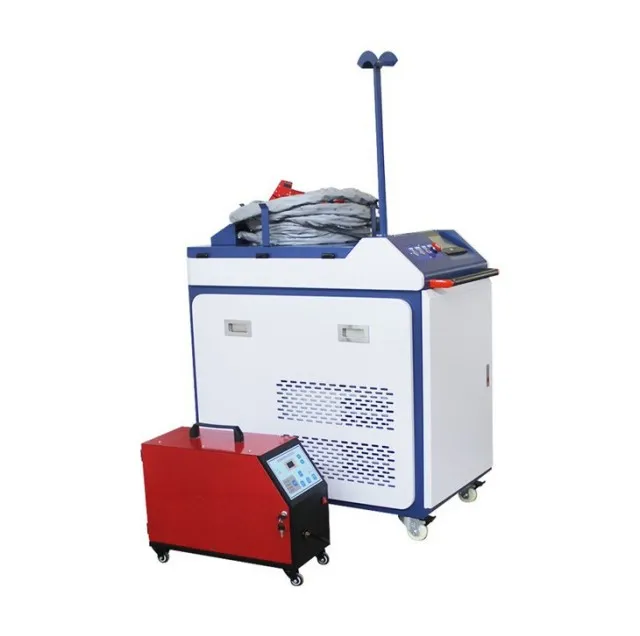
Laser welder is a welding machine that uses a focused beam of high energy light to fuse materials together. It works by shining a focused beam of laser light onto the surfaces of the materials to be welded, forcing them to melt and fuse together at the point of contact. Laser welders are quite well-known for their precision, speed, and versatility, making them ideal for a wide range of applications across industries. They are widely employed in manufacturing processes for metals, polymers, and other materials that demand high-quality and precise welding.
Lasers increase weld speed
Lasers can weld many times faster (up to 5 to 10 times faster) than traditional methods. Even without considering the decrease in post-processing, it’s easy to understand that faster weld speeds mean a quicker turnaround time and increased productivity.
Versatility
Laser welding is extremely versatile. Different laser setups can weld just about anything and everything: thick steel plates for the shipping industry, precious metals for jewelry, dissimilar metals like aluminum and steel, or the copper contacts on electric car batteries.
Higher accuracy
Laser welding produces a very narrow laser beam that can be focused very precisely on the area to be welded, even in areas as small as millimeters in diameter. In addition to more precise control of the welding process, it also avoids wastage and errors of welding material and ensures consistent quality.
High-quality welds
One of the main advantages of laser welding is that it produces higher-quality welds. That’s because laser welding creates a narrower and deeper weld than other methods, creating a stronger bond between the two pieces of metal and can withstand extreme temperatures and harsh environments. The uniform pulse of laser welding results in a very clean seam after laser welding without the beading or burrs that are inevitable in gas-shielded or electric welding.
Rich Experience
UNISTRCNC boasts professional technical and research teams with extensive experience in CNC routers, ATC CNC routers, laser machines, laser cutting machines, laser marking machines, CNC metal engraving machines, CNC plasma cutting machines, and fiber metal cutting machines.
Professional Team
Shandong Unistar Machinery Co.,Ltd specializes in manufacturing and exporting CNC machines and laser machines since 2002. The company operates two large factories, one dedicated to CNC routers and the other to laser machines.
Certificate of Qualification
All our products have obtained CE, FDA, and SASO certificates, ensuring quality assurance.
Problem Solving
Our technical engineers solve customer problems promptly, ensuring customer satisfaction and worry-free machine usage.
How Does Laser Welding Machine Work
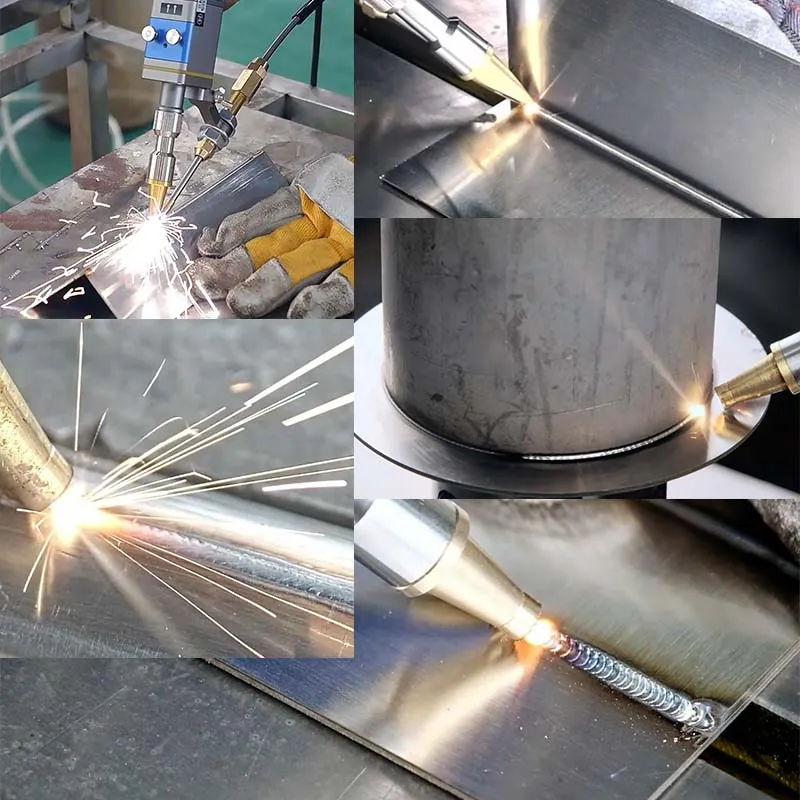
Laser welding is a technique that uses a focused collimated high-intensity beam of light to melt and fuse metal parts, sometimes with extra material from a filler rod. The process works by generating laser light and then delivering it to a collimator/optics head. It is then focused onto the junction of the metal parts, causing a highly localized heat buildup and restricted melt pool.
The laser welding beam is typically generated by a solid-state, fiber, or CO2 laser, each of which has relative advantages. At the beam’s focus point, the metal reaches its melting point and forms a localized pool, into which the filler rod can be melted as required. The laser beam is then moved along the surface of the joint. This melts a leading edge and leaves the molten, fused trailing edge of the pool to cool and solidify. In a successful weld, the cooled metal attaches to both parts to a roughly equal degree and remains free of oxidation.
What Is the Process of Laser Welding Machine
Clean the parts to be welded and position them accurately. The contact line should be closed and gap-free to improve weld quality.
Use manual clamps or automated fixtures to hold parts in place and keep them stable during the welding process.
Adjust the beam’s focal point onto the welding area. The optical gear in the welding torch usually provides for easy adjustment of focus.
Adjust the beam power and test it on scrap material and trial parts. Before moving to the workpiece, make sure it is putting out sufficient energy to melt the material but not enough to excessively heat parts.
Apply the beam at the start of the welding area. Once an appropriate melt pool has formed, it must be traversed along the weld in a steady motion. Traditional welding techniques such as hot point rotation will encourage good fusion and improve the weld quality.
Cool the part naturally once the welding is complete. You can also quench it in water or use other cooling methods.
What Kinds of Materials Can be Welded Using Laser Welding Machine
Metals: Examples are: Aluminum, copper, brass, steel, titanium, and nickel. The process can be used to join pieces of significantly divergent thicknesses, increasing its applications to a wider selection of tasks than traditional thermal or electrical welding methods.
Plastics. Lasers can be used to weld some thermoplastics, including: polycarbonate, nylon, and ABS. Low heating and highly localized melting result in quality welds.
Ceramics. Some ceramics (particularly alumina and zirconia) can be laser welded. These and some other ceramics can be melted and fused via laser in a way that is much harder to achieve by normal thermal means.
Composites. Carbon fiber-reinforced plastics (CFRPs) are amenable to this technique. There is also advanced research and early success in laser welding metal parts to carbon fiber composites.
What Are the Different Types of Laser Welding Machine Welding
Conduction Welding: This method uses the lowest power rating of any laser-based approach. It merges the melted edges by capillary action alone, with no filler. This approach is best suited to welding precisely fitted edges of thin materials.
Deep Penetration Welding: This method is suitable for welding thicker materials. It uses high laser power to heat a deep and wide portion of the material. In general, the laser is first used to cut a keyhole that penetrates through the material (ensuring full-thickness welding). The resulting hole is then closed with a molten filler rod at its trailing edge, as the laser progresses along the weld.
Laser Spot Welding: This method is best used for small, complex parts. The laser creates small, localized welds. These spot welds can make point joints between edges, or melt through one part to merge with the part below.
Laser Seam Welding: This approach makes long, continuous seams. It often uses a filler rod to create a filet at the joint using similar pool control motions to those seen in electrical and traditional thermal methods.
Hybrid Laser Welding: This method mixes laser and other welding processes such as MIG and TIG. Combining processes in this way can give you the advantages of both systems.
CO2 (Carbon Dioxide) laser welding machine
The CO2 laser stands out as a prominent example of gas laser welding. Its defining characteristic lies in utilizing carbon dioxide as a medium to amplify light. In particular, it is possible to perform uniform and high-strength welding when welding materials with a thickness of 10 mm or more or over large areas of several tens of square centimeters or more. It is also possible to weld resin, etc., so it is used in a wide range of fields.Another feature is that capable of stable continuous operation for long periods of time, allowing continuous work to be carried out on large-scale production lines. CO2 lasers are mainly used in the automotive industry but also play a pivotal role in advancing manufacturing processes.
YAG laser
The YAG laser is a great example of solid-state laser welding technology. It uses a crystal with a garnet structure as its medium. Due to its characteristics as a pulsed laser, it repeats blinking at small time intervals. Because the wavelength is shorter than that of CO2 laser, energy absorption rate by metal is high and welding is easy.In addition, it has excellent coherency and laser spreading performance, and is easy to use as it has excellent laser light collection and diffusion. These qualities make them well-suited for welding precision components and delicate tasks.. YAG lasers are mainly used in medical device manufacturing.
Fiber laser welding machine
A fiber laser is a type of solid-state laser that uses an optical fiber as its medium. Its remarkable efficiency comes from confining light within a slender fiber and then amplifying it, enabling exceptionally clean welding.With a short wavelength and the capability to narrow down the spot, fiber lasers boast high energy density, facilitating deep penetration into highly reflective materials like aluminum and copper. It is also used for welding dissimilar metals together.
Disc laser welding machine
A disk laser is a type of solid-state laser. A crystal doped with rare earth elements such as ytterbium is used as the medium.These lasers are designed with the aim of overcoming a common issue found in solid-state lasers: a decline in welding accuracy. Traditional solid-state lasers encounter a challenge where heat generated during operation causes uneven temperature distribution in the laser crystal, leading to a thermal lens effect. This effect occurs because the crystal’s refractive index behaves akin to that of a lens, resulting in reduced laser focusing power.Disk lasers solve this problem by making the laser crystal into a thin disk shape and attaching a heat sink to the back, resulting in higher welding accuracy than previous solid-state lasers. Disk lasers are commonly used in the aerospace industry.
Semiconductor laser welding machine
A semiconductor laser is a type of solid-state laser. Mainly semiconductor materials are used as the medium. It’s also known by other terms such as diode laser or laser diode.What sets semiconductor lasers apart is their unique heat source: the laser light generated when an electric current passes through the semiconductor.
In the automotive industry, laser welding machines are used for body spot welding and seam welding.The main reason why laser welding machines are used in manufacturing processes in the automotive industry is because Car assembly welding sometimes requires precision work. Laser welding machines are capable of extremely fast and precise welding, and are compatible with automation, contributing to efficiency and quality improvement in automobile manufacturing.
In the electronic component manufacturing industry, laser welding machines are used for spot welding of fine wires and pins.Electronic component manufacturing requires precision processing. Laser welding machines can meet these demands. It is also possible to handle different materials and minimize heat damage to parts. These characteristics of laser welding machines contribute to consistent quality maintenance of electronic components.
In the aerospace industry, laser welders are used to manufacture parts that require high strength to withstand safety standards.Parts and products needed in the aerospace industry require durable quality and light weight. Laser welding machines are capable of high-strength welding and can handle a wide variety of materials, making them more efficient and lightweight.
Medical device manufacturers use laser welding machines to assemble and repair precision medical equipment.For example, it is often used in the following manufacturing processes and also finds use in reparing different electrical components.When manufacturing medical devices, extremely high safety and quality standards must be met, and one manufacturing tool that can meet these standards is a laser welder.
Laser welding machines are widely used by jewelry manufacturers because they require delicate and precise welding capabilities. The jewelry making process involves assembling small parts and attempting to realize complex designs.Another reason for its use is that the range of thermal effects is small, so there is less risk of damaging expensive materials such as gold and platinum. Laser welding machines can perform welding at a level that satisfies the above conditions, so they are used in a wide range of applications in the jewelry industry.
Laser welding machines are also widely used in the manufacture of mechanical products other than the automobiles and medical devices mentioned above. Machine manufacturers use laser welding machines to assemble precision machine parts. It is commonly used in the automotive and medical device industries, but it can also be used for assembly of large structures and work that requires high-quality surface treatment.
1. Regularly check and replace the internal circulating water
The secret of the handheld laser welding machine to ensure high output efficiency lies in the high purity of the cooling water because the high purity of the cooling water is a key factor to ensure the updated output power and laser life. The centralized spray gun assembly can achieve better maintenance, and the service life of the fiber laser welding machine is longer. The conductivity of the internal circulating water should be checked once a week, and the deionized water of the internal circulating water should be replaced once a month. At this time, attention should be paid to the conductivity of the newly injected pure water. Within the specified range. When replacing deionized water, please pay attention to the color change of the ion exchange column in the cooling system.
2. Regularly check the output spot of the laser
In order to better ensure that the output light spot of the laser tends to be stable, the operator needs to check the output light spot of the laser frequently with black photographic paper. If it is found that the output spot is unbalanced or the energy is reduced, the laser resonator needs to be adjusted in time to ensure the quality of the light output by the laser and prevent people from directly viewing the laser as much as possible. daily work. If you want to operate or debug the fiber laser welding machine, the debugger must be equipped with special laser protective glasses.In short, the daily maintenance of the handheld laser fiber laser welding machine requires regular inspection of the circulating water in the equipment, and at the same time, the deionized water in the internal circulating water needs to be replaced.
